

Can You Put Wall Graphics on Brick, Block or Textured Walls?
Yes. Most interior brick, concrete block and textured walls can take printed graphics. The catch is that a rough wall needs a different film, a different install method and a closer look at the wall itself than smooth drywall does.
That matters in Chicago. Many offices sit in converted brick lofts in the West Loop, Fulton Market and River North. Schools, gyms and warehouses across the suburbs are built from painted concrete block. Those walls are often exactly where a business wants its brand to show, as with brand walls in loft offices.
Below, we cover wall graphics on brick, block and textured drywall: the materials that work on each, the conditions that stop an install, and how we test a wall before anything goes to print. If you’re still choosing a material, start with our overview of custom wall coverings in Chicago.
Which walls can take graphics? The short answer by wall type
Start with this table, which covers the walls we see most often. The sections below explain each row.
| Wall Type | Can it take graphics? | Best Approach | Watch for |
|---|---|---|---|
|
Smooth painted drywall |
Yes, the easiest surface |
Standard wall vinyl or printed wallcovering |
Fresh or flat paint |
|
Light orange peel |
Usually |
Standard or high-tack wall film, tested first |
Texture showing through thin films
|
|
Knockdown or skip trowel |
Yes, with the right film |
High-tack wall film, or a skim coat before wall covering
|
Edges lifting on high points |
|
Heavy texture or popcorn |
Not directly |
Skim coat the wall, or mount the graphic on panels |
Light orange peel |
|
Painted brick |
Yes |
Heat-conformable film made for textured walls |
Peeling or chalky paint
|
|
Raw or Wall type |
Often, after Can it take graphics? |
Clean and seal if needed, then Best approach |
Dust, porosity, Watch for |
|
unsealed brick |
a test |
heat-conformable film |
moisture |
|
Painted concrete block |
Yes |
Heat-conformable film, or wallcovering over a liner |
Deep mortar joints |
|
Raw concrete block |
Often, after prep |
Seal or paint, let it cure, then install |
Moisture and efflorescence |
|
Poured concrete |
Yes, if sealed and dry |
Seal, then high-tack or heat-conformable film |
Dust and moisture |
Why rough walls are harder
Adhesive only grips where it touches. On smooth drywall that’s almost the whole graphic. On brick, the brick faces make contact, but unless the film is heated and pressed in, it bridges over the mortar joints and leaves weak spots.
Masonry also behaves differently from drywall. Brick and block are porous, so they can soak up adhesive and hold moisture that works against it. On painted brick, the bond is only as good as the paint underneath: flaking paint lets go before the graphic does.
None of this rules out a rough wall. It just means the material, the install and the prep all have to be chosen for that wall.
Wall graphics on exposed brick
Painted brick vs. raw brick
Painted brick is usually the easier of the two, as long as the paint is sound. Paint fills some of the surface pores and gives the adhesive a more even surface. Before we quote, we check that the paint isn’t peeling, chalky or freshly applied.
Raw brick is more porous and often dusty. Depending on its condition, it may need cleaning and a sealer first, and it always gets a test patch. Some older Chicago brick is soft at the surface. If the face rubs off on your hand, no adhesive will hold to it.
How a brick wall install works
Brick needs a thin, conformable cast vinyl made for textured surfaces, not standard wall vinyl. The installer heats the film and rolls it into the brick faces and mortar joints so it follows the shape of every brick. Done well, it reads more like paint than a sticker.
It’s specialized work with specialized tools. 3M’s film for textured surfaces, for example, conforms to brick and concrete when it is heated and applied with 3M’s own rollers. Those tools call for a heat gun that reaches at least 1,000°F.
What to expect from vinyl on a brick wall
Graphics on brick look great, but set expectations honestly:
- Shorter lifespan than on smooth walls. 3M rates its textured-surface film at up to 2 years indoors.
- Joints are the weak point. Deep or uneven mortar joints are where lift shows first.
- Texture is part of the look. From across the room the image reads cleanly. Up close, you’ll see the brick through it.
- Removal takes heat and care. That matters if you lease the space (more on adhesives below).
Graphics on concrete block (cinder block) walls
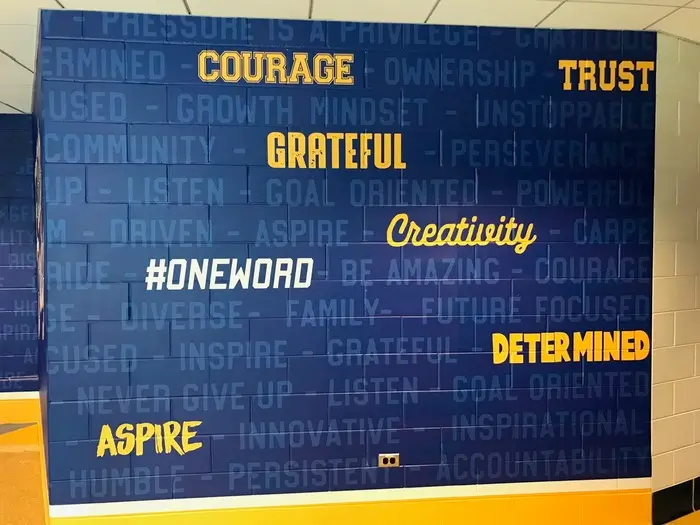
Painted concrete block is common in schools, gyms, stairwells, warehouses and lower-level offices. It’s a good candidate for graphics, and there are two ways to approach it:
- Vinyl applied direct. A heat-conformable film goes straight onto painted block and follows the joints, the same way it does on brick. It’s the faster option, and the block texture stays visible through the graphic.
- Wallcovering over a smooth base. For a smooth, finished wall, printed wallcovering can go over block once the wall has a liner or skim coat, so the block pattern doesn’t show through. It takes more prep, but the result looks like a finished interior wall rather than painted block.
- Block walls that face the outside or sit below grade need a moisture check first. White, powdery deposits along the joints are efflorescence, a sign that water is moving through the wall. More on that below.
Wallpaper and graphics on textured drywall
Most textured drywall is easier than masonry, but the texture still decides the material:
1) Light orange peel: Standard wall films often hold fine. We still test, because the same texture name can mean very different depths from one building to the next.
2) Knockdown or skip trowel: A high-tack wall film is usually needed. For printed wallcovering, a skim coat first gives the cleanest result.
3) Heavy texture or popcorn: Graphics won’t bond reliably. The wall needs a skim coat, or the graphic can be mounted on panels instead.
Thin films can also show texture through the print, especially where window light rakes across the wall.
Vinyl wrap, wallcovering or mounted panels?
There are three ways to put a graphic on a rough wall. Compare them here, or see our guide to compare wall graphics materials for more on each.
| Option | Best for | How it looks | Removal |
|---|---|---|---|
|
Heat-conformable vinyl |
Brick, block or concrete you want to keep visible |
Follows the texture and reads like paint |
Takes heat; depends on the adhesive |
|
Printed wallcovering over a liner or skim coat |
Block or heavy texture where you want a smooth, finished wall |
Smooth, seamless interior finish |
Removed like other commercial wallcovering
|
|
Mounted panels |
Historic brick, landlord limits, damp or very rough walls |
Clean graphic that sits just off the wall
|
Take the panels down; only the fastener holes are left |
Mounted panels are often overlooked. When a wall can’t be touched or won’t hold an adhesive, mounted or hanging wall graphics get the image up without bonding anything to the masonry.
Permanent or removable adhesive?
On porous masonry, the adhesive decides how the graphic comes off later. Permanent adhesive bonds deep into brick or block, and removal can pull paint or brick face with it. High-tack removable films still grip textured walls but release more cleanly within their rated window. That suits seasonal displays and leased spaces.
The protective laminate matters too. It has to flex as much as the film does. A stiff laminate fights the texture and lifts at the joints, so we pair a conformable laminate with a conformable film.
When we’d tell you not to install yet
Some walls need work, or time, before a graphic will hold. We’ll recommend waiting if we see:
1) Moisture or efflorescence. White, powdery salt deposits, often in bands along mortar joints, mean water is moving through the masonry. The moisture source has to be fixed and the wall dried out before anything goes on it.
2) Crumbling mortar or failing paint. A graphic can’t hold onto a surface that’s coming apart.
3) Fresh paint or sealer. Paint has to cure before vinyl goes over it. Guidance runs from at least 7 days to 30 days, depending on the film maker. [Confirm: Benchmark’s cure-time rule.] [INTERNAL LINK: /how-long-after-painting-install-wall-graphics “how long to wait after painting”]
4) Cold walls. Adhesive won’t bond to a cold surface, and one trade guide sets 40°F as the minimum. In a Chicago winter, that rules out unheated warehouses, vestibules and exterior walls until it warms up. [Confirm: Benchmark’s minimum install temperature.]
5) Water-repellent sealers. Some masonry sealers are designed to repel everything, adhesive included. A test patch tells us.
How we test a rough wall before printing
- You send photos. Send one straight-on shot of the wall, one close-up with a coin or tape measure for scale, and the dimensions. Upload them with your quote request.
- We check the wall. We look at texture depth, paint condition, moisture, surface temperature and any sealers. [Confirm: whether site visits are offered.]
- We run a test patch. The actual film goes on the actual wall, and we check adhesion.
- We recommend a material and method. You get our recommendation, a realistic lifespan and a proof to approve before anything prints.
- We print and install. Our professional graphics installation team heat-applies the graphic and checks every edge and joint.
Frequently asked questions
Can you put a vinyl mural on a brick wall?
Yes. Brick needs a thin, heat-conformable film made for textured surfaces. The installer heats it and rolls it into the mortar joints so it follows each brick. Standard wall vinyl bridges the joints and lifts.
Can wall graphics go on painted brick?
Usually, as long as the paint is well bonded and fully cured. Peeling or chalky paint has to be fixed first, or it will fail before the graphic does.
Will removing a wall graphic damage brick or block?
It depends on the adhesive. Permanent adhesive can pull paint or brick face when it comes off. Removable high-tack films release more cleanly within their rated window, so they’re the safer choice for leased spaces.
Can you put wallpaper or a mural on a cinder block wall?
Yes. Vinyl can go straight onto painted block. Printed wallcovering needs a wall liner or skim coat first, so the block pattern doesn’t show through the finished wall.
Can peel-and-stick wallpaper go on textured walls?
Light orange peel often works. Knockdown and heavier textures usually need a high-tack film or a skim coat. Popcorn texture needs smoothing, or a mounted panel instead.
How long do graphics last on brick or textured walls?
Not as long as on smooth walls. 3M rates its textured-surface film at up to 2 years indoors. Wallcovering over a properly prepared wall is the longer-term option.
Do you need to seal brick or concrete before installing graphics?
Sometimes. Raw, dusty or very porous masonry may need a sealer, fully cured, before installation. Some water-repellent sealers block adhesion, so a test patch decides.
Can you install wall graphics on brick in a Chicago winter?
Indoors in a heated space, yes. Cold walls, frost and condensation stop adhesive from bonding, so unheated spaces and exterior brick usually wait for warmer weather.